Imposter syndrome is the feeling of not being enough, even when there are real achievements that contradict it. It has nothing to do with what you do, but with how you see yourself. It's an internal perception that leads you to doubt your worth, even if externally everything indicates the opposite.
Many people live with this feeling without fully identifying it. It's that persistent idea that, deep down, you're not as valid as others believe. As if at any moment someone is going to realize that you're not up to par.
The disconcerting thing is that it doesn't depend on results. You can strive, advance, achieve goals… and still feel that it's not enough. As if what you achieve doesn't quite belong to you.
Behind this often lies a relationship with oneself based on demandingness. A way of constantly evaluating yourself, comparing yourself, feeling that you could always have done more. When something goes well, you explain it from external factors: luck, circumstances, a one-time effort. When something doesn't go as expected, you turn it into proof that you're not worthy enough.
But it's not a problem of ability. It's a filter.
A filter that makes you look at everything you do from doubt instead of recognition. That places you in a position of constant self-demand, where nothing ever feels sufficient.
Therefore, breaking free from this pattern isn't about doing more. It's about changing your relationship with yourself. By learning to recognize what you do accomplish, by allowing yourself to fail without questioning yourself as a person, and by reviewing that internal dialogue that pushes you to invalidate yourself.
Because it's not about becoming someone better.
It's about stopping treating yourself as if you weren't.
And although this phenomenon can appear in anyone, research shows that it is especially frequent in women. Some studies indicate that up to 75% of them have experienced it at some point in their professional lives (RRHH Digital, 2023), and that, in general, they tend to score higher in these types of thoughts than men (Psychology Today, 2021).
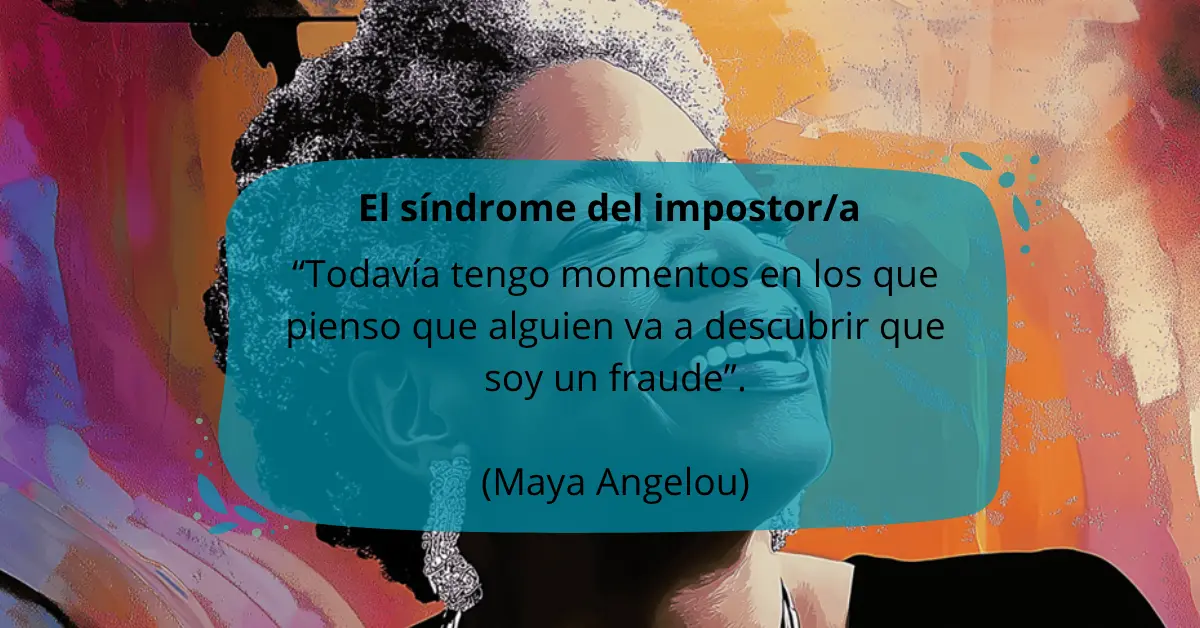
Even Maya Angelou, one of the most influential voices in contemporary literature and culture, admitted to having occasionally felt that someone would discover she wasn't as valid as she seemed. It's striking that a woman with such a solid career and international recognition could experience this internal doubt. And precisely therein lies the key to imposter syndrome: it doesn't understand achievements or success, but rather the way a person perceives themselves. Her testimony reminds us that it's not a question of ability, but of perspective, and that even those we admire have also had to face that feeling of not being enough.
As Maya Angelou said:
“I still have moments when I think someone’s going to discover I’m a fraud.”
And yet, she wasn't.
And probably, neither are you.
Bibliography
Clance, P. R., & Imes, S. A. (1978). The imposter phenomenon in high achieving women: Dynamics and therapeutic intervention. Psychotherapy: Theory, Research & Practice, 15(3), 241–247.
Bravata, D. M., et al. (2020). Prevalence, predictors, and treatment of impostor syndrome: a systematic review. Journal of General Internal Medicine, 35(4), 1252–1275.
RRHH Digital (2023). More than 70% of women claim to have experienced imposter syndrome at some point in their career.
Psychology Today (2021). The gender divide in imposter syndrome.